

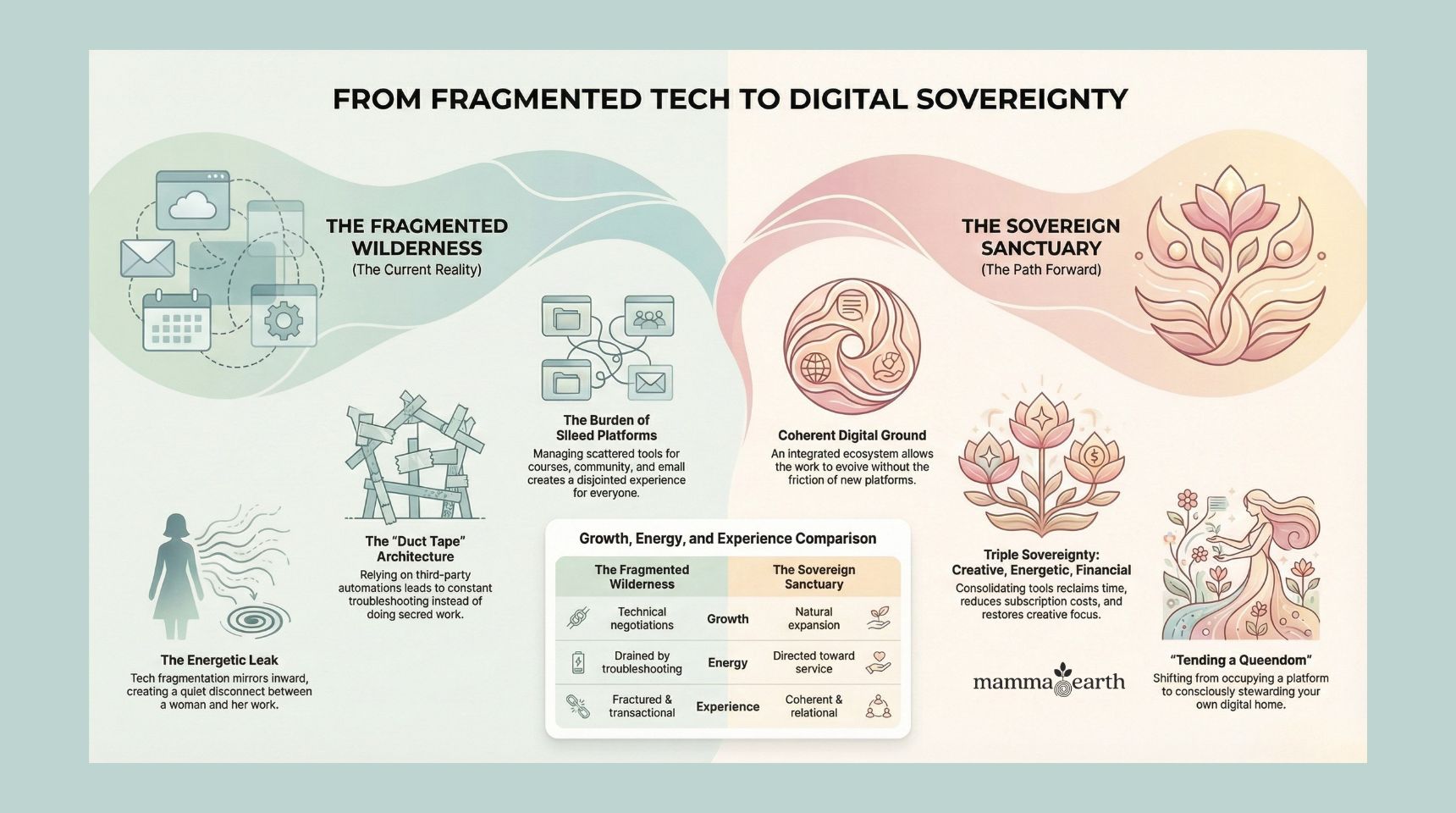
It is a landscape of scattered platforms — courses hosted in one tool, community conversations held in another, client bookings managed through a third, email marketing running on a fourth, and a website sitting somewhere else entirely, built years ago on a system that no longer reflects the depth of the work it was meant to represent.
This is the fragmented digital landscape that almost every modern business owner inherits. Not because they chose it, but because of how online tools evolved.
Table of Contents
How We Learned to Build in Fragments
The Cost of the Familiar Wilderness
The Threshold That Is Not About Technology
What Becomes Possible on Sovereign Ground
How We Learned to Build in Fragments
Big tech did not evolve as an interconnected ecosystem. It evolved in silos.
One platform built the best course host. Another built an email marketing engine. Another focused strictly on calendar scheduling. Another on community forums. Each solved one isolated problem — and each required its own subscription, its own login, its own distinct logic, and its own steep learning curve.
The industry promised integration: Connect them with third-party tools. Automate the bridges. Make them talk to each other.
The reality, however, is digital duct tape.
Every new growth stage — from launching your first offering to managing a full portfolio of programs — requires re-entering the tech wilderness. It is the frustrating territory where you stop focusing on your core work and start troubleshooting broken connections between tools that were never designed to live together.
Each new threshold costs time, focus, and money. And each time, you emerge a little more fatigued, a little more resigned to the friction.
This is not a personal failure; it is a structural inheritance. The dominant software architecture of the web was built for quick, transactional interactions — not for relational, living, and community-driven businesses.
And that external fragmentation eventually mirrors inward.
As digital technology accelerates, the pressure to keep up quietly reshapes how you relate to your own work. There is always another platform to master, another plugin to update, and a new expectation for what a professional online setup demands.
And so you build the only way the landscape has taught you — adding one more software subscription, one more bridge — because it feels like the only option.
With each addition, the distance grows between the true vision of your business and the technology supporting it. The course doesn't quite carry the same voice as the community. The emails feel disconnected from the live experience. Each piece functions, but together, they lack cohesion.
That is the hidden cost: not just the monthly software bills or the hours lost to tech support, but the subtle erosion of clarity at the center of your work.
The Cost of the Familiar Wilderness
Once a founder realizes their digital house is fractured, a predictable pattern unfolds.
They stay put.
Not because the current setup works well, but because navigating the familiar chaos requires less immediate effort than starting over. They’ve already spent months learning each tool, wiring imperfect integrations, and training clients or members to navigate five different logins.
The cost of starting fresh — migrating content, updating pathways, learning new systems — feels like an impossible weight to carry alongside the daily operations of a business.
So they adapt. They build awkward workarounds. They accept client confusion and energy leaks as standard operating costs.
This is the familiar wilderness: the compromise of staying on ground that is chaotic simply because it is known.
What is rarely discussed is that the familiar wilderness isn't neutral. It compounds. Every month spent managing fragmented systems deepens fatigue, widens the gap between you and your creation, and quietly alters your client relationships — because you are asking them to navigate the friction alongside you.
Work designed to engage, educate, or transform is delivered through infrastructure that fragments the very experience it offers.
The Threshold That Is Not About Technology
Beneath the practical resistance — the time, the budget, the learning curve — lies a deeper threshold.
It isn't a technical decision. It is an identity-level shift.
Leaving the familiar wilderness means stepping into full authorship of the digital ground your work stands on. It is not just picking a new app; it is claiming responsibility for the architecture itself — how your audience arrives, how they move through your offerings, and how your business is experienced as one coherent body.
This is what digital sovereignty actually means.
Not independence from technology, but conscious stewardship of the infrastructure supporting your life's work. A founder who steps across this threshold is no longer managing a scattered collection of vendors. They are tending an integrated home for everything they have built and everything they are creating next.
There is a vast difference between a digital landscape that is simply occupied and one that is intentionally tended.
A fragmented tech landscape is occupied — you exist within it, work around its limitations, and make do. A sovereign digital home is tended — designed with intention, built around the shape of your specific ecosystem, and alive with the same care you bring to your customers, members, and clients.
The shift asks something real. It asks you to view your business not as a series of disconnected tools, but as a complete ecosystem. It asks you to believe that your work deserves stable ground, and to view your infrastructure not as an inescapable burden, but as a foundation you own and control.
What Becomes Possible on Sovereign Ground
A woman standing on coherent ground does not begin her day in the gaps between systems. She begins in the roots of her work.
This is where growth changes shape entirely. When the infrastructure holds, growth is no longer a series of technical negotiations — finding the next platform, learning the next integration, paying for the next subscription to solve a problem the last one created.
Growth becomes what it was always meant to be: the natural expansion of a body of work that is alive, rooted, and ready.
A new programme does not require a new platform. A deeper level of client care does not demand another tool. A course that wants to become a school, a practice that is
What Becomes Possible on Sovereign Ground
When you stand on coherent ground, you don't begin your day in the gaps between systems. You begin in the roots of your work.
This is where growth changes shape entirely. When the infrastructure holds, scaling is no longer a series of painful technical negotiations — finding the next platform, setting up complex zaps, or paying for additional add-ons to fix problems created by your existing tools.
Growth becomes what it was always meant to be: the natural expansion of a strong vision.
A new program does not require a new platform. A deeper level of engagement does not demand another plugin. A single course evolving into a full academy, or a private practice expanding into a membership — these unfold within the same home, because the architecture was built for your business to evolve.
This is creative sovereignty — the freedom to shape your offerings, content, and client pathways on your own terms, free from the limitations of rigid platform templates.
Alongside creative sovereignty comes its energetic counterpart.
The persistent drain of managing scattered systems — the cognitive load of tracking where content lives, the background anxiety of broken automations, the hours lost to customer support — stops. Your energy is no longer consumed by bridging disconnected tools. It returns to you, fully available to direct toward your community and core craft.
Financial sovereignty follows naturally.
Multiple subscriptions collapse into one consolidated model. Resources previously scattered across four or five software vendors return to your bottom line. What once flowed outward to sustain disparate ecosystems can now be reinvested into growing your own.
These three — creative, energetic, and financial — are not separate freedoms. They are one unified sovereignty. And together, they fundamentally change what you are capable of building.
A guide can welcome a client from their first point of contact through a full learning pathway without a single point of technical friction.
A leader hosting a community, educational programs, and communications under one roof can foster lasting engagement that fragmented systems simply cannot sustain.
This is what digital ownership looks like when it becomes an asset rather than a headache. You are no longer managing software; you are stewarding an ecosystem that reflects your values and grows alongside you.
The Remembering
Every creator and builder who makes this move out of the wilderness describes something remarkably similar. It isn't just the relief of having fewer password logins; it is a return to why they started in the first place.
When the infrastructure works seamlessly, when the pathways are clear, and when the technology operates in harmony with your vision, something essential returns:
Clarity in your core operations.
Steadiness in how you deliver value.
Spaciousness that had been slowly eroded by tech sprawl.
The fragmented digital landscape we inherited was never built for holistic, relational businesses. But the landscape you choose moving forward can be.
There is a better, more integrated way to build online — ground designed for the full depth and ambition of what you hold.
Ready to bring your digital house under one roof? Explore how Pollen provides the coherent foundation your business deserves.
]]>