

There is a moment in the life of every independent founder when the fundamental question shifts.
It is no longer “How do I earn as much as possible as fast as possible?” but “How do I build a revenue model that sustains my life, my business, and my clients without burning out the ground I stand on?”
This is the threshold where sustainable pricing begins — not in a cold spreadsheet, but in a reckoning. A reckoning with a business culture that measures success exclusively in perpetual expansion, treats "more" as the only acceptable direction, and has no language for the founder who looks at her life and business and says: This is enough.
Enough is not a retreat. It is a foundation.
Table of Contents
The Guilt at the Centre of Every Pricing Decision
Pricing as Circulation, Not Extraction
The Circulation Principle: A Framework for Sustainable Pricing
1. What does your actual life need?
2. What does the business itself need?
3. What do you want to return?
The Courage It Takes to Say: This Is Enough
The Guilt at the Centre of Every Pricing Decision
Most educators, community builders, consultants, and practitioners carry a distinct weight when it comes to money. The work they do is deeply relational, personal, and transformative.
Traditional business advice whispers two conflicting narratives:
Undercharge: Feel guilty about asking for money, treat pricing like a compromise, and absorb all technical and operational costs personally.
Overcharge: Follow a growth-hack guru who says to "charge high-ticket" simply because you can, leaving you with a number that feels borrowed, inflated, and unrooted in real value.
Neither approach is sustainable.
Too low, and you eventually resent the work you love because your margins are thin and your tech bills are high. Too high, and you feel disconnected from the very audience you built your business to serve. The pendulum swings, and the simple question — “What should I charge?” — becomes one of the most emotionally exhausting decisions in your business.
This is not a personal failure. It is the natural consequence of trying to build a human-centered, relational business inside an extractive economic playbook.
Pricing as Circulation, Not Extraction
In the natural world, nothing extracts without returning. The fallen leaf feeds the soil, the soil nourishes the roots, and the roots feed the tree that eventually drops the leaf. There is no extraction in a healthy ecosystem — only circulation, a continuous movement of energy and nourishment from one form to another.
Your pricing structure can operate the same way.
When you charge for your programs, memberships, or services, you are not extracting value from your community. You are keeping a healthy ecosystem in motion. What a client pays flows directly into your capacity to rest, innovate, improve your platform, support your team, and remain present for the next person who enters your community.
What flows in nourishes what flows out. This is the economics of regeneration, not relentless accumulation.
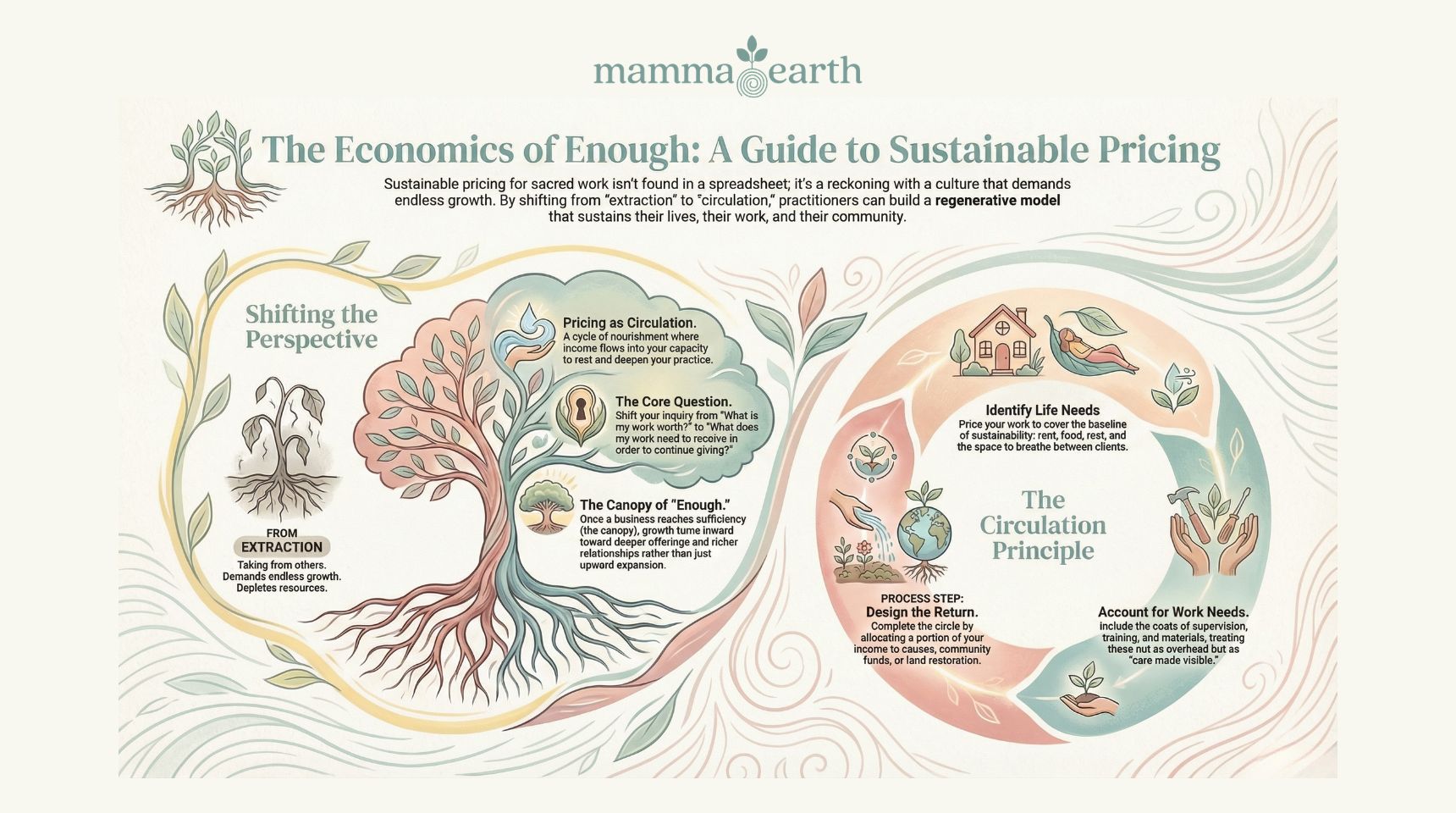
Author Charles Eisenstein highlights the difference between a purely transactional economy and one built on circulation and reciprocity. The core question is not "What am I worth?" — a question that invites endless self-doubt and subjective debate. The real question is:
"What does my business need to receive in order to continuously deliver exceptional value?"
That question has a clear, grounded, and measurable answer.
The Circulation Principle: A Framework for Sustainable Pricing
The Circulation Principle is an operational approach to pricing that moves beyond both guilt and arbitrary formulas. It asks three straightforward questions that form the foundation beneath your numbers:
1. What does your actual life need?
Not an inflated five-year investor deck — your real life. Your living expenses, health care, rest, professional development, and the operational space to breathe between projects. This is your baseline for personal sustainability. Your business must cover this baseline, or the work will eventually collapse under the weight of uncounted personal sacrifice.
2. What does the business itself need?
Every sustainable practice has legitimate costs that preserve its quality — continuous learning, quality software infrastructure, software platform hosting, member support, and legal foundations. These are not annoying "overhead"; they are care made visible. They belong in your pricing because they directly protect the quality of the client experience.
3. What do you want to return?
Regenerative pricing includes circulation beyond the individual founder. A portion of revenue might support community scholarships, environmental initiatives, open-access resources, or local causes. This isn't charity; it is completing the loop of a healthy business ecosystem.
When these three streams are accounted for honestly, the resulting price isn't arbitrary. It isn't borrowed from a competitor's landing page. It is rooted in reality, aligned with your operational costs, and designed to keep the cycle healthy.
The Courage It Takes to Say: This Is Enough
The dominant tech narrative has no ceiling. More ARR, more subscribers, more scale, more noise.
A founder who defines her version of "sufficiency" and chooses to build within it is quietly radical. She is refusing the only metric the traditional market knows how to measure.
"Enough" does not mean standing still. A forest that reaches its canopy does not stop growing — it deepens. It distributes nutrients through fungal networks to younger growth. It becomes more complex, interconnected, and resilient. It grows in richness rather than pure height.
A sustainable model for independent founders works identically. Once your baseline canopy is reached — your living is secured, your operational stack is funded, and your revenue flows predictably — growth turns inward:
Richer member experiences.
Higher-touch client care.
More spacious creative cycles.
Deeper, more refined curriculum.
The energy once spent chasing endless, chaotic acquisition returns to strengthening your core foundation. This is not a lack of ambition; it is the long-term ambition traditional business models forgot to name.
What This Means for Your Business
If you are an independent founder, creator, or practitioner reading this and recognizing the cycle — the pricing guilt, the platform sprawl, and the fatigue of fitting your vision into a hyper-growth box — consider these realizations:
You might notice your prices were set by someone else's launch formula, rather than the actual operational costs of your life and software stack.
You might notice you’ve been pushing for audience volume without asking if your business model actually required it.
You might notice that the word “enough” brings a mix of immediate relief and operational clarity.
All of that is honest, actionable ground.
The Circulation Principle doesn't dictate whether you should raise or lower your prices. It asks you to root them — in what your life requires, what your infrastructure costs, and what kind of value you want to circulate. It invites you to build a revenue model that regenerates your energy rather than depleting it.
The Ground Beneath the Price
There is a business model that traditional metrics fail to measure:
It is the economics of the creator who rests between launches because her platform margins allow it.
It is the educator who spends summers researching and updating her curriculum because her business funds sabbatical periods.
It is the founder who serves her community generously because she isn't exhausted by managing six different software tools and razor-thin margins.
This is the economics of enough.
It is neither scarcity nor excessive greed. It is the steady, regenerative circulation of value — from the people you serve, through the infrastructure you build, and back out into the world as an enduring body of work.
Build your business on solid, sustainable ground.
Pollen gives independent creators, educators, and leaders the unified platform they need to host courses, build communities, handle client care, and streamline operations — so you can keep your overhead low and your energy focused where it belongs.
]]>